1The idea
Every Vietnamese syllable is written as one square, like a Nôm character. Its initial and its final consonant are familiar Hán characters, read by the first sound of their reading: 巴 ba is b, 木 mộc is m. The vowel is a small stroke on the right, the tone a small mark. If you know Hán Nôm, you only learn the vowel strokes and five tone marks.
A Hán character, on the left
A stroke, on the right
A Hán character too, below
A small mark, at the bottom
Phiên âm tự (PA, phonetic annotation) was made to help with learning Nôm. It uses only what a learner of Hán Nôm learns anyway. And it keeps the pronunciation out of the way: Quốc Ngữ and IPA are so familiar that the eye reads them at once, and with the sound often the meaning, before one has looked at the character. PA is read only when you want to: a hint you can choose not to look at.
2A syllable
Watch a syllable being put together. The top holds the initial and the vowel, the bottom the final and the tone.
- One sound, one sign: c, k, q are all 工; g, gh are 几; ng, ngh are 乂.
- A syllable without an initial (ăn, em) starts with 𠂎, the left half of the Nôm 𧘇 ấy.
- qu is 工 with a glide: the glide is an extra horizontal bar on the vowel stroke.
- The finals -u, -o and -i, -y are written with the vowel strokes ô and i.
- No mark is the level tone (ngang).
3Initials
23 Hán characters. Under each is the reading that gives the sound; a few take their Nôm reading, as hardly any Sino-Vietnamese word starts with r or gh. Tap to hear it.
4Vowels
14 vowel strokes. This is the only part to learn by heart. Tap for an example.
With a glide (oa, uy, quê …): one more horizontal bar
5Finals
The same characters as the initials: -p is 巴 like b. Only -nh takes 儿, a variant of 人, so that it is not mistaken for the sắc mark. -u and -i are the vowel strokes ô and i.
6Tones
Five marks. Without a final the mark stands below the syllable; with a final it sits in the final's block.
The same marks with the final -m
7Try it
8Read
The first four lines of Truyện Kiều. Read each word yourself, then tap it to check; the speaker reads the whole line.
The first four lines of a Nôm translation of Nam quốc sơn hà. Here PA is the annotation: a small syllable stands over the Nôm character (the character, then a control character, then the PA syllable). Tap a character to see the Quốc Ngữ.
9The full chart
Every initial with every vowel (not all of them occur in Vietnamese).
Open the chart
On the desktop: the PA characters are in the font QATT Pen, to download from the font catalogue.
PA on your phone
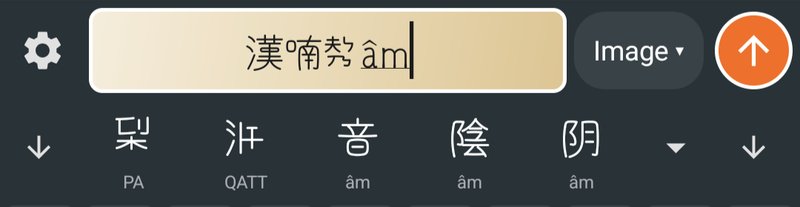
QATTKey, a keyboard for Android, writes PA, QATT and Chữ Nôm in any app: type Quốc Ngữ with Telex and pick the PA character among the candidates.
Get the keyboard